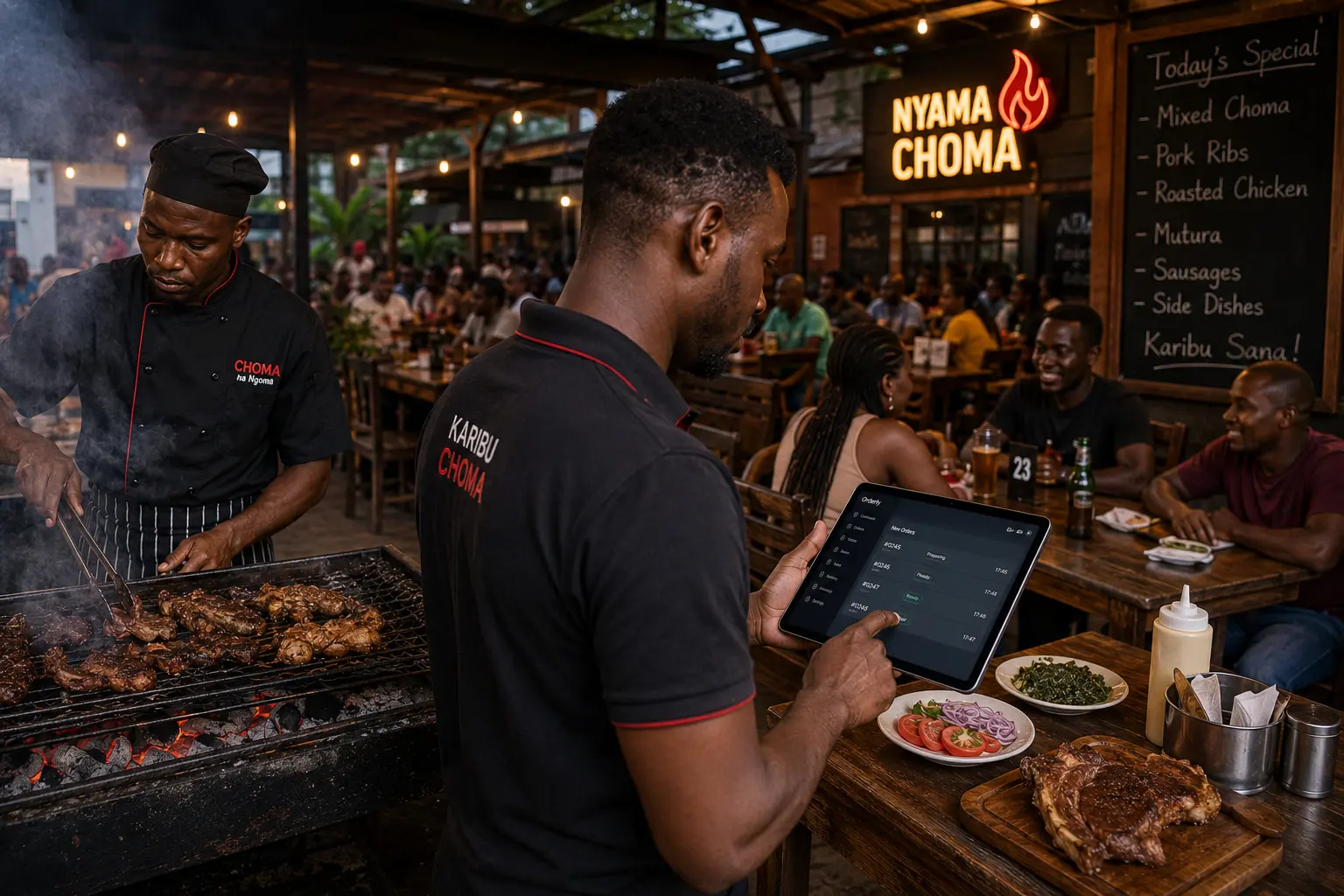


The licences a Kenyan restaurant needs before it opens, the tax and staff registrations, and a setup checklist for your first month.
The short answer: to open a restaurant in Kenya you need a registered business and a KRA PIN, a county business permit, a public health licence for the premises, medical certificates for everyone who handles food, and a fire safety certificate. Add a liquor licence if you will sell alcohol, and set up KRA eTIMS before your first sale. Fees and steps differ from county to county, so confirm the details with your county offices before you pay anyone.
The licences, in the order you usually get them
- Register the business. A business name or a limited company, through the Business Registration Service on eCitizen.
- Get a KRA PIN for the business on iTax. You will need it for almost everything after this.
- County business permit. Issued by the county where your premises is, and renewed every year. The fee depends on the size and type of business and where it is.
- Public health licence. A county public health officer inspects the kitchen, water, toilets, drainage and food storage before you open.
- Medical certificates for food handlers. Everyone who handles food, including cooks, waiters and the person washing up, needs a medical examination and certificate. These are usually renewed every six months.
- Fire safety certificate. The county fire department checks your extinguishers, exits and how you store gas.
- Liquor licence, if you will sell alcohol. It comes from your county's liquor licensing board and sets your selling hours.
- Signage permit, if you put up a sign outside. This also comes from the county.
- Music licence, if you play music for customers. It comes from the music copyright bodies.
Tax and staff, from day one
- KRA eTIMS. KRA expects your sales invoices to go through eTIMS, its electronic invoicing system. Starting on it is far easier than switching later. Read the eTIMS guide.
- Staff. Register as an employer with NSSF and the Social Health Authority (SHA), and deduct and pay PAYE and the housing levy for your employees.
- Records. Keep every receipt for stock, rent and equipment. Your accountant will ask, and so will KRA.
Your setup checklist for the first month
- A short menu, priced properly. Fewer dishes means less waste. Work out the cost per plate before you print prices.
- An M-Pesa till. Apply to Safaricom for a Lipa na M-Pesa Buy Goods till, and decide which phone receives the confirmations. Then learn to spot fake M-Pesa messages.
- A POS from the first sale. Record every sale from day one. Your first month's numbers tell you what to cook, when to add staff and what to drop. See what hardware you actually need.
- Kitchen orders. A printer or a screen, so orders don't get lost between the counter and the kitchen. Printer or screen?
- Opening stock. Count everything before you open, and decide who receives deliveries.
- Cash rules. Who opens, who closes, and how the day's money is checked. Why cash drawers don't balance.
- Be easy to find. A Google Business Profile with photos and opening hours, a WhatsApp Business number, and a link where people can order straight from you.
How I help a new restaurant
- I am free to start, so you are not paying for software before you have customers.
- Send me a photo of your menu and I set it up for you.
- KRA eTIMS is free on every plan.
- I run on the phone, tablet or computer you already have.
- You get your own online ordering page, so regulars can order from you directly.
Related reading
- How much does a POS system cost in Kenya?
- KRA eTIMS for restaurants
- What POS hardware does a Kenyan restaurant actually need?
Opening soon? Start with me.
I am Orderly: the restaurant POS with M-Pesa, kitchen screen, stock and riders, built in Kenya. From KSh 5,000 a month per branch, no commission, and it is free to start.
Leave a comment
Your email address will not be published. Required fields are marked *